
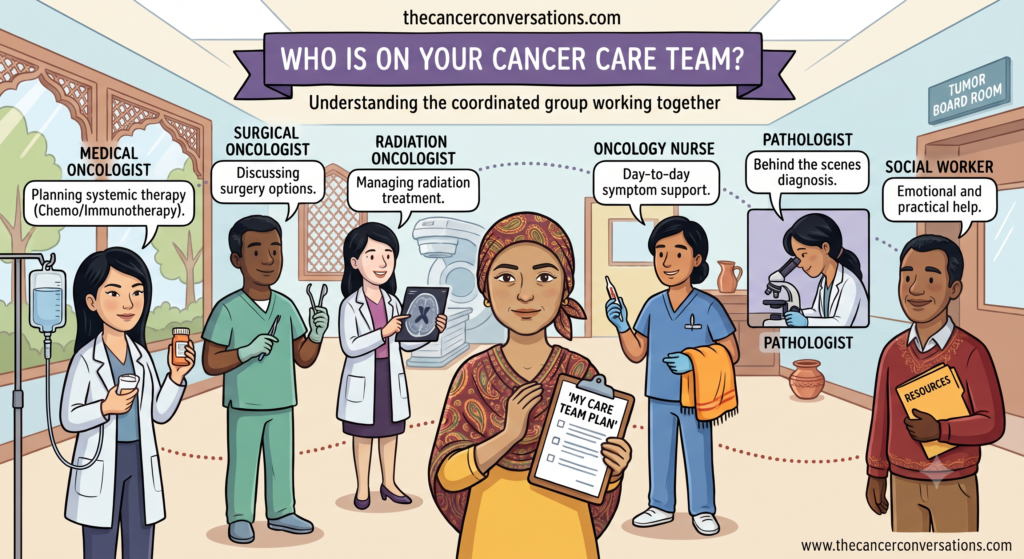
“Doctor, so many different people are involved in my treatment — who do I actually go to?”
This comes up constantly, and it’s a fair question. A cancer care team used to mean one doctor and one plan. It no longer works that way. Good cancer treatment now comes from a coordinated group of specialists working together, and understanding who’s on your cancer care team — and what each person is actually doing for you — is part of getting the most out of your care.
This piece walks through who’s typically on your cancer care team, why the person leading it changes as treatment progresses, and what’s worth asking when you’re deciding whether a team is right for you.
The core of your cancer care team
Most treatment plans are anchored by three specialists, though not every diagnosis needs all three.
The medical oncologist plans systemic therapy — chemotherapy, immunotherapy, targeted therapy, hormone therapy. The surgical oncologist plans and performs any surgery. The radiation oncologist plans and delivers radiation.
Which specialty leads at a given point depends on your treatment plan, and that can change as you move through it. In breast cancer, for example, chemotherapy is often given first to shrink the tumour, so the medical oncologist leads that phase. Surgery follows, led by the surgical oncologist. Radiation often comes after that, led by the radiation oncologist.
Why the “lead” changes — and why that isn’t a gap in your care
It helps to know this in advance, because it can otherwise feel confusing partway through treatment: whoever is most involved in your cancer care team will shift as you move between phases. A specialist who isn’t active in your current phase will often step back — not because they’ve stopped caring, but because they aren’t the one reviewing your latest results or making the next decision. It’s a division of labour, not a lapse in attention.
Whoever is leading at a given point is responsible for your care during that phase. What this does mean is that holding the full picture together across phases takes some deliberate effort. Some hospitals have a patient navigator or care coordinator for exactly this — scheduling, relaying results between specialists, keeping the overall picture in view. Where that role doesn’t formally exist, it’s worth asking your current lead specialist how continuity is handled, and keeping your own file of reports and results to carry between appointments.
The specialists working behind the scenes
Pathologists and radiologists shape your care even though you may rarely meet them. The pathologist reads your biopsy and interprets molecular and genomic testing; the radiologist interprets your scans. You don’t usually choose them, but the accuracy of their work underlies nearly every decision made about your treatment.
Your most frequent point of contact for day-to-day symptoms is usually your oncology nurse — the person who manages side effects between visits and is often the first call when something comes up unexpectedly.
The wider cancer care team: support beyond treatment
Treatment affects more than the tumour, and a second layer of the team exists for that.
Palliative care specialists focus on symptom control and quality of life. This is worth clearing up directly, because it’s a common point of confusion: palliative care is not end-of-life care. It can run alongside active treatment from early in your diagnosis, and a referral to palliative care doesn’t mean anything has changed for the worse.
Dietitians and physical or occupational therapists help manage appetite and taste changes, and maintain strength through fatigue and physical setbacks. Social workers and psycho-oncologists address the emotional weight of diagnosis and treatment, for you and your family, alongside practical stressors like work leave and caregiving. Financial navigators and case managers work through insurance approvals and cost-assistance programs.
Not every hospital offers all of these as formal roles, and not every patient needs all of them at once. Ask your care team directly what’s available, and raise a need as it comes up rather than waiting for it to be offered.
What’s worth asking when you’re evaluating a team
A few questions about your cancer care team are worth asking directly, whether you’re starting treatment or weighing a change.
Does the centre have a reasonable spread of specialists and enough patient volume to have real experience with situations like yours? This matters more than whether they’ve specifically seen your exact subtype before.
Is your case discussed at a multidisciplinary tumour board — a meeting where specialists from different disciplines review complex cases together before finalising a plan?
Do they explain things clearly without making you ask twice, and respond to questions within a reasonable time? Are they comfortable with you seeking outside input?
If you’re seeing specialists across different hospitals, do their records actually reach each other, or will you end up carrying results between them yourself? This last point causes more friction than almost anything else in care that spans more than one centre.
Second opinions are a normal part of care
Many patients hesitate to ask for a second opinion, worried it will offend their doctor or delay treatment. In practice, most oncologists — myself included — expect this and will help arrange it. It’s particularly worth pursuing for a rare cancer subtype, a diagnosis with more than one reasonable treatment path, or when something about the plan doesn’t sit right with you. Even when a second opinion simply confirms the original plan, it’s rarely a wasted step.
Building your cancer care team over time
You don’t need all of this in place in your first week. Most patients start with the core medical team and add supportive specialists as specific needs surface — palliative care when pain becomes hard to manage, a dietitian when eating becomes difficult, a social worker when the emotional load outpaces what family and friends can carry alone.
Before your next appointment, it can help to write down three things: who is currently on your team, what roles feel missing, and what you actually want answered at this visit. That preparation usually does more for a visit than anything else.
Your cancer care team will change shape as your treatment does. Knowing who’s on it, and why, is part of understanding your own care.
Links you may find of use
Decoding Your Pathology Report: Understanding Your Diagnosis https://www.cancer.gov/about-cancer/managing-care/services/providers